List of Birds in Thattekad Bird Sanctuary
Thattekad Bird Sanctuary, also known as Salim Ali Bird Sanctuary, is a paradise for bird watchers and nature lovers. Located in the Kothamangalam taluk of Kerala, India, it is home to over 300 species of birds, including rare and endemic ones. The sanctuary, spread across 25 square kilometers in the lush Western Ghats, features dense tropical evergreen and deciduous forests, grasslands, and marshes that provide ideal habitats for a wide range of bird species.
While Thattekad boasts incredible avian diversity, it's equally important to recognize which species are not found here. In this article, we provide a list of birds that are not typically recorded or observed within Thattekad Bird Sanctuary. This can help bird enthusiasts and researchers focus their efforts on spotting species that are native to the region while avoiding confusion with those not present.
- Painted francolin
 Painted francolin
( Francolinus pictus )
The painted francolin or painted partridge is a species of francolin found in grassy areas in central and southern India and in the lowlands of southeastern Sri Lanka. They are easily detected by their loud calls especially during the breeding season. - Grey francolin
 Grey francolin
( Francolinus )
The grey francolin is a species of francolin found in the plains and drier parts of the Indian subcontinent. This species was formerly also called the grey partridge, not to be confused with the European grey partridge. - Red spurfowl
 Red spurfowl
( Galloperdix spadicea )
The red spurfowl is a member of the pheasant family and is endemic to India. It is a bird of forests, and is quite secretive despite its size. It has a distinctive call and is often hard to see except for a few seconds when it flushes from the undergrowth. It appears reddish and like a long-tailed partridge - Painted spurfowl
 Painted spurfowl
( Galloperdix lunulata )
The painted spurfowl is a bird of the pheasant family found in rocky hill and scrub forests mainly in peninsular India. Males are more brightly coloured and spotted boldly in white. Males have two to four spurs while females can have one or two of the spurs on their tarsus. - Blue-breasted quail
 Blue-breasted quail
( Coturnix chinensis )
The king quail (Excalfactoria chinensis), also known as the blue-breasted quail, Asian blue quail, Chinese painted quail, or Chung-Chi, is a species of Old World quail in the family Phasianidae. - Common quail
 Common quail
( Coturnix coturnix )
The common quail, or European quail, is a small ground-nesting game bird in the pheasant family Phasianidae. Coturnix is the Latin for this species. With its characteristic call of "wet my lips", this species of quail is more often heard than seen - Rain quail
 Rain quail
( Coturnix coromandelica )
The rain quail or black-breasted quail is a species of quail found in the Indian subcontinent, its range including Pakistan, India, Nepal, Sri Lanka, Bangladesh, Myanmar, Thailand, Cambodia and Viet Nam - Jungle bush quail
 Jungle bush quail
( Perdicula asiatica )
The jungle bush quail is a species of quail found in the Indian subcontinent, ranging across India, Nepal, Bangladesh, Pakistan and Sri Lanka. Very different from the female, the male jungle bush quail has a white moustache, heavily barred white underparts, and variegated wings. - Rock bush quailh
 Rock bush quailh
( Perdicula argoondah )
The rock bush quail is a species of quail found in parts of peninsular India. It is a common species with a wide range and the IUCN has rated it as being of "least concern" - Painted bush quail
 Painted bush quail
( Perdicula erythrorhyncha )
The painted bush quail is a species of quail found in the hill forests of India. They move in small coveys on hillsides and are distinguished by their red bills and legs. They have a liquid alarm call and small groups will run in single file along paths before taking flight when flushed - Small buttonquail
 Small buttonquail
( Turnix sylvaticus )
The common buttonquail, Kurrichane buttonquail, small buttonquail, or Andalusian hemipode is a buttonquail, one of a small family of birds which resemble, but are unrelated to, the true quails. This species is resident from southern Spain and Africa through India and tropical Asia to Indonesia. - Yellow-legged buttonquail
 Yellow-legged buttonquail
( Turnix tanki )
The yellow-legged buttonquail is a buttonquail, one of a small family of birds which resemble, but are unrelated to, the true quails. They are endemic to the Indian subcontinent, East Asia and Southeast Asia. There are two recognised subspecies - Barred buttonquail
 Barred buttonquail
( Turnix suscitator )
The barred buttonquail or common bustard-quail is a buttonquail, one of a small family of birds which resemble, but are unrelated to, the true quails. This species is resident from India across tropical Asia to south China, Indonesia and the Philippines. - Red junglefowl
 Red junglefowl
( Gallus gallus )
The red junglefowl is a tropical bird in the family Phasianidae. They are the primary progenitor of the domestic chicken. The red junglefowls were first domesticated at least 5,000 years ago in India - Grey junglefowl
 Grey junglefowl
( NIL )
The grey junglefowl, also known as Sonnerat's junglefowl, is one of the wild ancestors of domestic fowl together with the red junglefowl and other junglefowls. A gene from the grey junglefowl is responsible for the yellow pigment in the legs and different body parts of all the domesticated chicken. - Indian peafowl
 Indian peafowl
( Pavo cristatus )
The Indian peafowl, also known as the common peafowl, and blue peafowl, is a large and brightly coloured bird, is a species of peafowl native to the Indian subcontinent, but introduced in many other parts of the world. - Fulvous whistling-duck
 Fulvous whistling-duck
( Dendrocygna bicolor )
The fulvous whistling duck or fulvous tree duck is a species of whistling duck that breeds across the world's tropical regions in much of Mexico and South America, the West Indies, the Southern United States, sub-Saharan Africa and the Indian subcontinent. - Lesser whistling-duck
 Lesser whistling-duck
( Dendrocygna javanica )
The lesser whistling duck, also known as Indian whistling duck or lesser whistling teal, is a species of whistling duck that breeds in the Indian subcontinent and Southeast Asia. They are nocturnal feeders that during the day may be found in flocks around lakes and wet paddy fields - Knob-billed duck
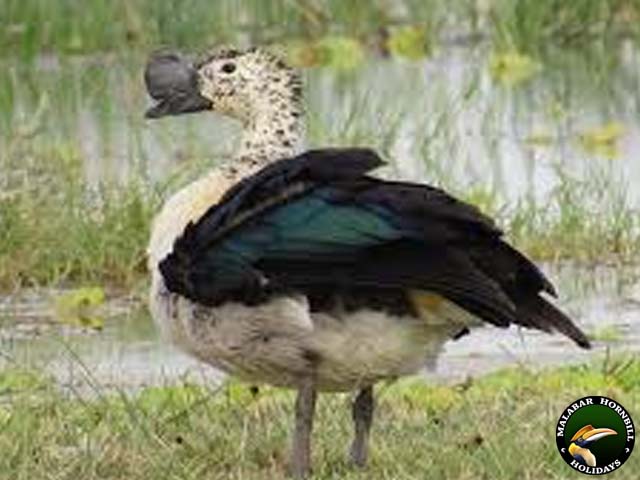 Knob-billed duck
( Sarkidiornis melanotos )
The knob-billed duck, or African comb duck, is a duck found in tropical wetlands in Sub-Saharan Africa, Madagascar and south Asia from Pakistan to Laos and extreme southern China. Most taxonomic authorities split this species and the comb duck from each other - Pink-headed duck
 Pink-headed duck
( Rhodonessa caryophyllacea )
The pink-headed duck was a large diving duck that was once found in parts of the Gangetic plains of India, Bangladesh and in the riverine swamps of Myanmar but feared extinct since the 1950s. Numerous searches have failed to provide any proof of continued existence - Cotton pygmy-goose
 Cotton pygmy-goose
( Nettapus coromandelianus )
The cotton pygmy goose or cotton teal is a small perching duck which breeds in Asia, Southeast Asia extending south and east to Queensland where they are sometimes called white-quilled pygmy goose - Bar-headed goose
 Bar-headed goose
( Anser indicus )
The bar-headed goose is a goose that breeds in Central Asia in colonies of thousands near mountain lakes and winters in South Asia, as far south as peninsular India. It lays three to eight eggs at a time in a ground nest. - Ruddy shelduck
 Ruddy shelduck
( Tadorna ferruginea )
The ruddy shelduck, known in India as the Brahminy duck, is a member of the family Anatidae. It is a distinctive waterfowl, 58 to 70 cm in length with a wingspan of 110 to 135 cm. - Common shelduck
 Common shelduck
( Tadorna tadorna )
The common shelduck is a waterfowl species of the shelduck genus, Tadorna. It is widespread and common in Eurasia, mainly breeding in temperate and wintering in subtropical regions; in winter, it can also be found in the Maghreb. Its scientific name comes from the French name Tadorne for this species - Gadwall
 Gadwall
( Mareca strepera )
The gadwall is a bird of open wetlands, such as prairie or steppe lakes, wet grassland or marshes with dense fringing vegetation, and usually feeds by dabbling for plant food with head submerged. It nests on the ground, often some distance from water. - Eurasian wigeon
 Eurasian wigeon
( Mareca penelope )
The Eurasian wigeon, also known as widgeon (Mareca penelope) is one of three species of wigeon in the dabbling duck genus Mareca. It is common and widespread within its range. - Mallard
 Mallard
( Anas platyrhynchos )
The mallard is a dabbling duck that breeds throughout the temperate and subtropical Americas, Eurasia, and North Africa and has been introduced to New Zealand, Australia, Peru, Brazil, Uruguay, Argentina, Chile, Colombia, the Falkland Islands, and South Africa. - Spot-billed duck
 Spot-billed duck
( Anas poecilorhyncha )
The Indian spot-billed duck is a large dabbling duck that is a non-migratory breeding duck throughout freshwater wetlands in the Indian subcontinent. The name is derived from the red spot at the base of the bill that is found in the mainland Indian population. - Common teal
 Common teal
( Anas crecca )
The Eurasian teal, common teal, or Eurasian green-winged teal is a common and widespread duck which breeds in temperate Eurasia and migrates south in winter. The Eurasian teal is often called simply the teal due to being the only one of these small dabbling ducks in much of its range. - Northern pintail
 Northern pintail
( Anas acuta )
The pintail or northern pintail is a duck with wide geographic distribution that breeds in the northern areas of Europe, Asia and North America. It is migratory and winters south of its breeding range to the equator. - Northern shoveler
 Northern shoveler
( Anas clypeata )
Perhaps the most outwardly distinctive of the dabbling ducks thanks to its large spoon-shaped bill, the Northern Shoveler busily forages head down in shallow wetlands. Its uniquely shaped bill has comblike projections along its edges, which filter out tiny crustaceans and seeds from the water. - Garganey
 Garganey
( Anas querquedula )
The garganey is a scarce and very secretive breeding duck in the UK. It is smaller than a mallard and slightly bigger than a teal. The male is most easily recognised with a broad white stripe over the eye. In flight it shows a pale blue forewing. It feeds by 'dabbling'. - Red-crested pochard
 Red-crested pochard
( Netta rufina )
The red-crested pochard is a large diving duck. The scientific name is derived from Greek Netta "duck", and Latin rufina, "golden-red". Its breeding habitat is lowland marshes and lakes in southern Europe and Central Asia, wintering in the Indian Subcontinent and Africa - Common pochard
 Common pochard
( Aythya ferina )
The common pochard is a medium-sized diving duck. The scientific name is derived from Greek aithuia an unidentified seabird mentioned by authors including Hesychius and Aristotle, and Latin ferina, "wild game", from ferus, "wild". - Ferruginous pochard
 Ferruginous pochard
( Aythya nyroca )
The ferruginous duck, also ferruginous pochard, common white-eye or white-eyed pochard is a medium-sized diving duck from Eurasia. The scientific name is derived from Greek aithuia an unidentified seabird mentioned by authors including Hesychius and Aristotle, and nyrok, the Russian name for a duck - Tufted duck
 Tufted duck
( Aythya fuligula )
The tufted duck is a small diving duck with a population of close to one million birds, found in northern Eurasia. The scientific name is derived from Ancient Greek aithuia an unidentified seabird mentioned by authors including Hesychius and Aristotle, and Latin, fuligo "soot" and gula "throat". - Eurasian wryneck
 Eurasian wryneck
( Jynx torquilla )
The Eurasian wryneck or northern wryneck is a species of wryneck in the woodpecker family. This species mainly breeds in temperate regions of Europe and Asia - Speckled piculet
 Speckled piculet
( Picumnus innominatus )
The speckled piculet is a species of bird in the family Picidae - Brown-capped pygmy woodpecker
 Brown-capped pygmy woodpecker
( Dendrocopos nanus )
The brown-capped pygmy woodpecker or Indian pygmy woodpecker is a species of very small woodpecker found in Nepal, India and Sri Lanka. Some taxonomic authorities continue to place this species in the genus Dendrocopos or Picoides - Fulvous-breasted woodpecker
 Fulvous-breasted woodpecker
( Dendrocopos macei )
The fulvous-breasted woodpecker is a species of bird in the family Picidae. It is found in Bangladesh, Bhutan, Nepal, India and Myanmar. The freckle-breasted woodpecker was formerly considered conspecific with this species - Yellow-crowned woodpecker
 Yellow-crowned woodpecker
( Leiopicus mahrattensis )
The yellow-crowned woodpecker or Mahratta woodpecker is a species of small pied woodpecker found in the Indian subcontinent. - Rufous woodpecker
 Rufous woodpecker
( Micropternus brachyurus )
The rufous woodpecker is a medium-sized brown woodpecker found in South and Southeast Asia. It is short-billed, foraging in pairs on small insects, particularly ants and termites, in scrub, evergreem, - Heart-spotted woodpecker
 Heart-spotted woodpecker
( Hemicircus canente )
The heart-spotted woodpecker is a species of bird in the woodpecker family. They have a contrasting black and white pattern, a distinctively stubby body with a large wedge-shaped head making them easy - White-bellied woodpecker
 White-bellied woodpecker
( Dryocopus javensis )
The white-bellied woodpecker or great black woodpecker is found in evergreen forests of tropical Asia, including the Indian subcontinent and Southeast Asia. It has 14 subspecies, part of a complex including the Andaman woodpecker. Many island forms are endangered, some are extinct. - Lesser yellownape
 Lesser yellownape
( Picus chlorolophus )
The lesser yellownape is a type of woodpecker which is a widespread and often common breeder in tropical and sub-tropical Asia, primarily the Indian subcontinent and Southeast Asia. - Greater yellownape
 Greater yellownape
( Chrysophlegma flavinucha )
The greater yellownape is a species of bird in the family Picidae. It is found in East Asia from northern and eastern India to south-eastern China, Indochina, Hainan, and Sumatra. Its natural habitats are subtropical or tropical moist lowland forest and subtropical or tropical moist montane forest. - Streak-throated woodpecker
 Streak-throated woodpecker
( Picus xanthopygaeus )
The streak-throated woodpecker is a species of woodpecker found in the Indian subcontinent. - Common flameback
 Common flameback
( Dinopium javanense )
The common flameback or common goldenback is a species of bird in the family Picidae. It is found in Bangladesh, Brunei, Cambodia, China, India, Indonesia, Laos, Malaysia, Myanmar, Singapore, Thailand, and Vietnam. The spot-throated flameback is sometimes considered a subspecies. - Black-rumped flameback
 Black-rumped flameback
( Dinopium benghalense )
The black-rumped flameback, also known as the lesser golden-backed woodpecker or lesser goldenback, is a woodpecker found widely distributed in the Indian subcontinent. It is one of the few woodpeckers that are seen in urban areas. It has a characteristic rattling-whinnying call and an undulating flight. - Greater flameback
 Greater flameback
( Chrysocolaptes guttacristatus )
The greater flameback also known as greater goldenback, large golden-backed woodpecker or Malherbe's golden-backed woodpecker, is a woodpecker species. It occurs widely in the Indian subcontinent, eastwards to southern China, the Malay Peninsula, Sumatra, western and central Java and northeast Borneo. - White-naped woodpecker
 White-naped woodpecker
( Chrysocolaptes festivus )
The white-naped woodpecker is a woodpecker which is a widespread but scarce breeder in the Indian Subcontinent. This flameback is a species associated with open forest and scrub with some trees. It nests in a tree hole, laying one or two white eggs. - Brown-headed barbet
 Brown-headed barbet
( Megalaima zeylanica )
The brown-headed barbet is an Asian barbet species native to the Indian subcontinent, where it inhabits tropical and subtropical moist broadleaf forests. It is widespread from the Terai in both Nepal and India to Sri Lanka, and listed as Least Concern on the IUCN Red List. - White-cheeked barbet
 White-cheeked barbet
( Megalaima viridis )
The white-cheeked barbet or small green barbet is a species of barbet found in southern India. It is very similar to the more widespread brown-headed barbet but this species has a distinctive supercilium - Malabar barbet
 Malabar barbet
( Megalaima malabarica )
The Malabar barbet is an Asian barbet native to the Western Ghats in India. It was formerly treated as a race of the crimson-fronted barbet. It overlaps in some places with the range of the coppersmith barbet and has a similar but more rapid call - Coppersmith barbet
 Coppersmith barbet
( Megalaima haemacephala )
The coppersmith barbet, also called crimson-breasted barbet and coppersmith, is an Asian barbet with crimson forehead and throat, known for its metronomic call that sounds similar to a coppersmith striking metal with a hammer. It is a resident bird in the Indian subcontinent and parts of Southeast Asia. - Malabar grey hornbill
 Malabar grey hornbill
( Ocyceros griseus )
The Malabar grey hornbill is a hornbill endemic to the Western Ghats and associated hills of southern India. They have a large beak but lack the casque that is prominent in some other hornbill species. They are found mainly in dense forest and around rubber, arecanut or coffee plantations. - Indian grey hornbill
 Indian grey hornbill
( Ocyceros birostris )
The Indian grey hornbill is a common hornbill found on the Indian subcontinent. It is mostly arboreal and is commonly sighted in pairs. It has grey feathers all over the body with a light grey or dull white belly. The horn is black or dark grey with a casque extending to the point of curvature of the horn - Malabar pied hornbill
 Malabar pied hornbill
( Anthracoceros coronatus )
The Malabar pied hornbill, also known as lesser pied hornbill, is a bird in the hornbill family, a family of tropical near-passerine birds found in the Old World. - Oriental pied hornbill
 Oriental pied hornbill
( Anthracoceros albirostris )
he oriental pied hornbill is an Indo-Malayan pied hornbill, a large canopy-dwelling bird belonging to the family Bucerotidae. Two other common names for this species are sunda pied hornbill and Malaysian pied hornbill. The species is considered to be among the smallest and most common of the Asian hornbills. - Great hornbill
 Great hornbill
( Buceros bicornis )
The great hornbill also known as the concave-casqued hornbill, great Indian hornbill or great pied hornbill, is one of the larger members of the hornbill family. It is found in the Indian subcontinent and Southeast Asia. Its impressive size and colour have made it important in many tribal cultures and rituals. - Common hoopoe
 Common hoopoe
( Upupidae )
Hoopoes are colourful birds found across Afro-Eurasia, notable for their distinctive "crown" of feathers. Three living and one extinct species are recognized, though for many years all were lumped as a single species—Upupa epops - Malabar trogon
 Malabar trogon
( Harpactes fasciatus )
The Malabar trogon is a species of bird in the trogon family. It is found in the forests of Sri Lanka and peninsular India. In India it is mainly found in the Western Ghats, hill forests of central India and in parts of the Eastern Ghats. - European roller
 European roller
( Coracias garrulus )
The European roller is the only member of the roller family of birds to breed in Europe. Its overall range extends into the Middle East, Central Asia and Morocco. The European roller is found in a wide variety of habitats, avoiding only treeless plains. - Indian roller
 Indian roller
( Coracias benghalensis )
The Indian roller is a bird of the family Coraciidae, the rollers. It occurs widely from West Asia to the Indian Subcontinent. It is listed as least concern on the IUCN Red List. It is best known for its aerobatic displays of males during the breeding season. - Dollarbird
 Dollarbird
( Eurystomus orientalis )
The Oriental dollarbird is a bird of the roller family, so named because of the distinctive blue coin-shaped spots on its wings. It can be found from Australia to Japan and India. - Pied kingfisher
 Pied kingfisher
( Ceryle rudis )
The pied kingfisher is a species of water kingfisher widely distributed across Africa and Asia. Originally described by Linnaeus in 1758, it has five recognised subspecies. Its black and white plumage and crest, as well as its habit of hovering over clear lakes and rivers before diving for fish, make it distinctive. - Common kingfisher
 Common kingfisher
( Alcedo atthis )
The pied kingfisher is a species of water kingfisher widely distributed across Africa and Asia. Originally described by Linnaeus in 1758, it has five recognised subspecies. Its black and white plumage and crest, as well as its habit of hovering over clear lakes and rivers before diving for fish, make it distinctive - Blue-eared kingfisher
 Blue-eared kingfisher
( Alcedo meninting )
The blue-eared kingfisher is found in Asia, ranging across the Indian subcontinent and Southeast Asia. It is found mainly in dense shaded forests where it hunts in small streams. - Oriental dwarf kingfisher
 Oriental dwarf kingfisher
( Ceyx erithaca )
The Oriental dwarf kingfisher (Ceyx erithaca), also known as the black-backed kingfisher or three-toed kingfisher, is a species of bird in the family Alcedinidae. A widespread resident of lowland forest, it is endemic across much of the Indian subcontinent and Southeast Asia. - Stork-billed kingfisher
 Stork-billed kingfisher
( Pelargopsis capensis )
The stork-billed kingfisher, is a tree kingfisher which is widely but sparsely distributed in the tropical Indian subcontinent and Southeast Asia, from India to Indonesia. This kingfisher is resident throughout its range. It is a very large kingfisher, measuring 35 cm in length - White-throated kingfisher
 White-throated kingfisher
( Halcyon smyrnensis )
The white-throated kingfisher also known as the white-breasted kingfisher is a tree kingfisher, widely distributed in Asia from the Sinai east through the Indian subcontinent to the Philippines. This kingfisher is a resident over much of its range, although some populations may make short distance movements. - Black-capped kingfisher
 Black-capped kingfisher
( Halcyon pileata )
The black-capped kingfisher is a tree kingfisher which is widely distributed in tropical Asia from India east to China, Korea and Southeast Asia. - Collared kingfisher
 Collared kingfisher
( Todiramphus chloris )
The collared kingfisher is a medium-sized kingfisher belonging to the subfamily Halcyoninae, the tree kingfishers. It is also known as the white-collared kingfisher or mangrove kingfisher. It has a wide range extending from the Red Sea across southern Asia to Polynesia. - Blue-bearded bee-eater
 Blue-bearded bee-eater
( Nyctyornis athertoni )
The blue-bearded bee-eater is a species of bee-eater found in much of the Indian subcontinent and parts of Southeast Asia. This bee-eater is found in forest clearings. It is found mainly in the Malayan region but extends west into peninsular India. - Green bee-eater
 Green bee-eater
( Merops orientalis )
The green bee-eater, also known as little green bee-eater, is a near passerine bird in the bee-eater family. - Blue-cheeked bee-eater
 Blue-cheeked bee-eater
( Merops persicus )
The blue-cheeked bee-eater is a near passerine bird in the bee-eater family, Meropidae. The genus name Merops is Ancient Greek for "bee-eater", and persicus is Latin for "Persian". It breeds in Northern Africa, and the Middle East from eastern Turkey to Kazakhstan and India. - Blue-tailed bee-eater
 Blue-tailed bee-eater
( Merops philippinus )
The blue-tailed bee-eater is a near passerine bird in the bee-eater family Meropidae. It breeds in southeastern Asia. It is strongly migratory, seen seasonally in much of peninsular India. This species is sometimes considered to be conspecific with the blue-cheeked bee-eater. - European bee-eater
 European bee-eater
( Merops apiaster )
The European bee-eater is a near passerine bird in the bee-eater family, Meropidae. It breeds in southern Europe and in parts of north Africa and western Asia. It is strongly migratory, wintering in tropical Africa - Chestnut-headed bee-eater
 Chestnut-headed bee-eater
( Merops leschenaulti )
The chestnut-headed bee-eater, or bay-headed bee-eater, is a near passerine bird in the bee-eater family Meropidae. It is a resident breeder in the Indian subcontinent and adjoining regions, ranging from India east to Southeast Asia. This species, like other bee-eaters, is a richly coloured, slender bird. - Pied cuckoo
 Pied cuckoo
( Clamator jacobinus )
The Jacobin cuckoo, pied cuckoo, or pied crested cuckoo is a member of the cuckoo order of birds that is found in Africa and Asia. It is partially migratory and in India, it has been considered a harbinger of the monsoon rains due to the timing of its arrival. - Chestnut-winged cuckoo
 Chestnut-winged cuckoo
( Clamator coromandus )
The chestnut-winged cuckoo or red-winged crested cuckoo is a cuckoo found in Southeast Asia and parts of South Asia. It has dark glossy upperparts, a black head with long crest chestnut wings, a long graduated glossy black tail, rufous throat dusky underside and a narrow white nuchal half collar. - Large hawk-cuckoo
 Large hawk-cuckoo
( Hierococcyx sparverioides )
The large hawk-cuckoo is a species of cuckoo in the Cuculidae family. It has a wide breeding distribution from temperate Asia along the Himalayas extending to East Asia. Many populations winter further south. - Common hawk-cuckoo
 Common hawk-cuckoo
( Hierococcyx varius )
The common hawk-cuckoo, popularly known as the brainfever bird, is a medium-sized cuckoo resident in the Indian subcontinent. It bears a close resemblance to the Shikra, even in its style of flying and landing on a perch. - Indian cuckoo
 Indian cuckoo
( Cuculus micropterus )
The Indian cuckoo is a member of the cuckoo order of birds, the Cuculiformes, that is found in the Indian subcontinent and Southeast Asia. It ranges from India, Bangladesh, Bhutan, Nepal and Sri Lanka east to Indonesia and north to China and Russia - Eurasian cuckoo
 Eurasian cuckoo
( Cuculus canorus )
The common cuckoo is a member of the cuckoo order of birds, Cuculiformes, which includes the roadrunners, the anis and the coucals. This species is a widespread summer migrant to Europe and Asia, and winters in Africa. - Lesser cuckoo
 Lesser cuckoo
( Cuculus poliocephalus )
The lesser cuckoo is a species of cuckoo in the family Cuculidae. It is found in Bangladesh, Bhutan, China, Democratic Republic of the Congo, Hong Kong, India, Japan, Kenya, North Korea, South Korea - Banded bay cuckoo
 Banded bay cuckoo
( Cacomantis sonneratii )
The banded bay cuckoo or bay-banded cuckoo is a species of small cuckoo found in the Indian subcontinent and Southeast Asia. Like others in the genus they have a round nostril. They are usually founded in well wooded areas mainly in the lower hills. - Grey-bellied cuckoo
 Grey-bellied cuckoo
( Cacomantis passerinus )
The grey-bellied cuckoo or the Indian plaintive cuckoo is a cuckoo with widespread occurrence throughout Asia. - Drongo cuckoo
 Drongo cuckoo
( Surniculus lugubris )
The square-tailed drongo-cuckoo is a species of cuckoo that resembles a black drongo. It is found in Sri Lanka and Southeast Asia and is a summer visitor to the Himalayas from Kashmir to eastern Bangladesh. The calls are series of piercing sharp whistles rising in pitch but shrill and choppily delivered. - Asian koel
 Asian koel
( Eudynamys scolopaceus )
The Asian koel is a member of the cuckoo order of birds, the Cuculiformes. It is found in the Indian Subcontinent, China, and Southeast Asia. It forms a superspecies with the closely related black-billed and Pacific koels which are sometimes treated as subspecies. - Green-billed malkoha
 Green-billed malkoha
( Phaenicophaeus tristis )
The green-billed malkoha is a species of non-parasitic cuckoo found throughout Indian Subcontinent and Southeast Asia. The birds are waxy bluish black with a long graduated tail with white tips to the tail feathers. The bill is prominent and curved. These birds are found in dry scrub and thin forests. - Blue-faced malkoha
 Blue-faced malkoha
( Phaenicophaeus viridirostris )
The blue-faced malkoha or small green-billed malkoha is a non-parasitic cuckoo found in the scrub and deciduous forests of peninsular India and Sri Lanka. It has a waxy, dark, blue-grey plumage on its upperparts and has a long tail with graduated white-tipped feathers - Sirkeer malkoha
 Sirkeer malkoha
( Phaenicophaeus leschenaultii )
The sirkeer malkoha or sirkeer cuckoo, is a non-parasitic cuckoo found in dry scrub forest and open woodland habitats in the Indian subcontinent. The species is long-tailed, largely olive brown on the upper side with a distinctive curved red beak tipped in yellow. - Greater coucal
 Greater coucal
( Centropus sinensis )
The greater coucal or crow pheasant, is a large non-parasitic member of the cuckoo order of birds, the Cuculiformes. A widespread resident in the Indian Subcontinent and Southeast Asia, it is divided into several subspecies, some being treated as full species - Lesser coucal
 Lesser coucal
( Centropus bengalensis )
The lesser coucal is a species of cuckoo in the family Cuculidae. It has a wide distribution range that overlaps with several other similar species. The habitat in which it is found is often marshy land with grass and tree cover. - Vernal hanging parrot
 Vernal hanging parrot
( Loriculus vernalis )
The vernal hanging parrot is a small parrot which is a resident breeder in the Indian subcontinent and some other areas of Southeast Asia. It undergoes local movements, driven mainly by the availability of the fruit, seeds, buds and blossoms that make up its diet. - Alexandrine parakeet
 Alexandrine parakeet
( Psittacula eupatria )
The Alexandrine parakeet, also known as the Alexandrine parrot or Burmese parakeet, is a medium-sized parrot in the genus Psittacula of the family Psittacidae - Rose-ringed parakeet
 Rose-ringed parakeet
( Psittacula krameri )
The rose-ringed parakeet, also known as the ring-necked parakeet, is a medium-sized parrot in the genus Psittacula, of the family Psittacidae. - Plum-headed parakeet
 Plum-headed parakeet
( Psittacula cyanocephala )
The plum-headed parakeet is a parrot in the family Psittacidae. It is endemic to the Indian Subcontinent and was once thought to be conspecific with the blossom-headed parakeet but was later elevated to a full species. - Malabar parakeet
 Malabar parakeet
( Psittacula columboides )
The blue-winged parakeet, also known as the Malabar parakeet is a species of parakeet endemic to the Western Ghats of southern India. Found in small flocks, they fly rapidly in forest clearings while making screeching calls that differ from those of other parakeet species within their distribution range - Indian swiftlet
 Indian swiftlet
( Aerodramus unicolor )
The Indian swiftlet, or Indian edible-nest swiftlet, is a small swift. It is a common resident colonial breeder in the hills of Sri Lanka and south west India. The half-cup nest is built on a vertical surface, often in a cave - White-rumped needletail
 White-rumped needletail
( Zoonavena sylvatica )
The white-rumped spinetail or white-rumped needletail is a species of swift found in the forests of Bangladesh, India and Nepal. It is often seen over waterbodies in the middle of forest. It can resemble a house swift but has a white vent. - Brown-backed needletail
 Brown-backed needletail
( Hirundapus giganteus )
The brown-backed needletail, or brown needletail, is a large swift. These birds have very short legs which they use only mainly for clinging to vertical surfaces. They never settle voluntarily on the ground and spend most of their lives in the air, living on the insects they catch in their beaks. - Asian palm swift
 Asian palm swift
( Cypsiurus balasiensis )
The Asian palm swift is a small swift. It is very similar to the African palm swift, Cypsiurus parvus, and was formerly considered to be the same species. It is a common resident breeder in tropical Asia from India to the Philippines. - Alpine swift
 Alpine swift
( Tachymarptis melba )
The Alpine swift formerly Apus melba, is a species of swift. The genus name is from the Ancient Greek takhus, "fast", and marptis, "seizer". The specific name melba comes from ‘melano-alba’ or ‘mel-alba’; Eigenhuis & Swaab posited that ‘melba’ might be a short form for ‘melano-alba’ or ‘mel-alba’. - Common swift
 Common swift
( Apus apus )
The common swift is a medium-sized bird, superficially similar to the barn swallow or house martin but somewhat larger, though not stemming from those passerine species, being in the order Apodiformes. The resemblances between the groups are due to convergent evolution, reflecting similar contextual development. - Blyth's swift
 Blyth's swift
( Apus leuconyx )
Blyth's swift, is a small bird, superficially similar to a house martin. It is, however, completely unrelated to those passerine species, since swifts are in the order Apodiformes. The resemblances between the groups are due to convergent evolution reflecting similar life styles - House swift
 House swift
( Apus nipalensis )
The house swift is a species of swift in the family Apodidae. It is found in Japan, Nepal, and Southeast Asia. It is capable of flying long distances by alternately shutting off hemispheres of their brain in-flight. In May 2012, one was discovered in Ladner, British Columbia, the first known sighting in North America - Crested treeswift
 Crested treeswift
( Hemiprocne coronata )
The crested treeswift is a kind of tree swift. It was for some time considered the same species as its eastern relative, the grey-rumped treeswift, but they do not interbreed where their ranges overlap. It is distinct in flight, with long, bowed wings and a deeply forked tail that usually appears narrow and pointed. - Barn owl
 Barn owl
( Tyto alba )
The barn owl is the most widely distributed species of owl and one of the most widespread of all birds. It is also referred to as the common barn owl, to distinguish it from other species in its family, Tytonidae, which forms one of the two main lineages of living owls, the other being the typical owls. - Grass owl
 Grass owl
( Tyto longimembris )
The eastern grass owl, or Australian grass owl is a species of owl in the family Tytonidae. They feed predominantly on small rodents. Though some authorities consider this owl to be conspecific with the African grass owl, T. capensis, other consider it to be a valid species. - Oriental bay owl
 Oriental bay owl
( Phodilus badius )
The oriental bay owl is a type of bay owl, usually classified with barn owls. It is completely nocturnal, and can be found throughout Southeast Asia. It has several subspecies. It has a heart-shaped face with earlike extensions. - Pallid scops owl
 Pallid scops owl
( Otus brucei )
The pallid scops owl is a small scops owl ranging from the Middle East to West and Central Asia, sometimes called the striated scops owl. - Oriental scops owl
 Oriental scops owl
( Otus sunia )
The oriental scops owl is a species of scops owl found in eastern and southern Asia. - Collared scops owl
 Collared scops owl
( Otus lettia )
The collared scops owl is an owl which is a resident breeder in south Asia from northern Pakistan, northern India, Nepal, Bangladesh and the Himalayas east to south China. It is partially migratory, with some birds wintering in India, Sri Lanka and Malaysia. - Jungle owlet
 Jungle owlet
( Glaucidium radiatum )
The jungle owlet, or barred jungle owlet, is found in the Indian Subcontinent. The species is often found singly, in pairs or small groups and are usually detected by their calls at dawn and dusk. There are two subspecies with the form found in the Western Ghats sometimes considered a full species. - Spotted owlet
 Spotted owlet
( Athene brama )
The spotted owlet is a small owl which breeds in tropical Asia from mainland India to Southeast Asia. A common resident of open habitats including farmland and human habitation, it has adapted to living in cities. They roost in small groups in the hollows of trees or in cavities in rocks or buildings. - Forest owlet
 Forest owlet
( Athene blewitti )
The forest owlet is an endangered owl that is endemic to the forests of central India. The species belongs to the typical owls family, Strigidae. First described in 1873, it was not sighted after 1884 and considered extinct. It was rediscovered in 1997 by Pamela Rasmussen. - Eurasian eagle owl
 Eurasian eagle owl
( Bubo bubo )
The Eurasian eagle-owl is a species of eagle-owl that resides in much of Eurasia. It is also called the European eagle-owl and in Europe, it is occasionally abbreviated to just eagle-owl. - Spot-bellied eagle owl
 Spot-bellied eagle owl
( Bubo nipalensis )
The spot-bellied eagle-owl, also known as the forest eagle-owl is a large bird of prey with a formidable appearance. It is a forest-inhabiting species found in the Indian Subcontinent and Southeast Asia. - Dusky eagle owl
 Dusky eagle owl
( Bubo coromandus )
DescriptionThe dusky eagle-owl is an owl species in the Strigidae family that is widespread in South and Southeast Asia. It is listed as Least Concern on the IUCN Red List. The species's extent of occurrence is estimated at 9,250,000 km². - Brown fish owl
 Brown fish owl
( Bubo zeylonensis )
The brown fish owl is a fish owl species in the family known as typical owls, Strigidae. It is native from Turkey to South and Southeast Asia. Due its wide distribution it is listed as Least Concern on the IUCN Red List. It inhabits forests and wooded wetlands. - Mottled wood owl
 Mottled wood owl
( Strix ocellata )
The mottled wood owl is a species of large owl found in India. They are found in gardens and thin deciduous forests adjacent to dry thorn forests or farmland. They are easily detected by their distinctive tremulous eerie calls at dawn and dusk - Brown wood owl
 Brown wood owl
( Strix leptogrammica )
The Brown Wood Owl is found in India, Bangladesh and Sri Lanka, east to western Indonesia, Taiwan, and south China. The brown wood owl is a resident breeder in south Asia. This species is a part of the family of owls known as typical owls, which contains most species of owl. It belongs to the earless owl genus Strix. - Brown hawk-owl Brown hawk-owl
( Ninox scutulata )
The brown hawk-owl, also known as the brown boobook, is an owl which is a resident breeder in south Asia from India, Sri Lanka, Bangladesh and Nepal east to western Indonesia and south China. This species is a part of the larger grouping of owls known as typical owls, Strigidae, which contains most species of owl. - Short-eared owl
 Short-eared owl
( Asio flammeus )
The short-eared owl is a species of typical owl. Owls belonging to genus Asio are known as the eared owls, as they have tufts of feathers resembling mammalian ears. These "ear" tufts may or may not be visible. - Sri Lanka frogmouth
 Sri Lanka frogmouth
( Batrachostomus moniliger )
The Sri Lanka frogmouth, Sri Lankan frogmouth or Ceylon frogmouth is a small frogmouth found in the Western Ghats of south India and Sri Lanka. Related to the nightjars, it is nocturnal and is found in forest habitats. - Great eared nightjar
 Great eared nightjar
( Lyncornis macrotis )
The great eared nightjar is a species of nightjar in the family Caprimulgidae. It is the largest species in the family in terms of length, which can range from 31 to 41 cm. Males weigh an average of 131 g and females weigh an average of 151 g so it the second heaviest species in the family after the nacunda nighthawk. - Grey nightjar
 Grey nightjar
( Caprimulgus jotaka )
The grey nightjar is a species of nightjar found in East Asia. It is sometimes treated as a subspecies of the jungle nightjar, its South Asian relative. - Large-tailed nightjar
 Large-tailed nightjar
( Caprimulgus macrurus )
The large-tailed nightjar is a species of nightjar in the family Caprimulgidae. It is found along the southern Himalayan foothills, eastern South Asia, Southeast Asia and northern Australia. - Jerdon's nightjar
 Jerdon's nightjar
( Caprimulgus atripennis )
Jerdon's nightjar is a medium-sized nightjar species which is found in southern India and Sri Lanka. Formerly considered as a subspecies of the long-tailed nightjar it is best recognized by its distinctive call which sounds like a wooden plank being beaten periodically with each note ending in a quaver. - Indian nightjar
 Indian nightjar
( Caprimulgus asiaticus )
The Indian nightjar is a small nightjar which is a resident breeder in open lands across South Asia and Southeast Asia. - Savanna nightjar
 Savanna nightjar
( Caprimulgus affinis )
The savanna nightjar is a species of nightjar found in South and Southeast Asia. Eight subspecies are recognised: C. a. monticolus, C. a. amoyensis, C. a. stictomus, C. a. affinis, C. a. timorensis, C. a. griseatus, C. a. mindanensis and C. a. propinquus. Its habitat is open forest and areas with scrub. - Rock pigeon
 Rock pigeon
( Columba livia )
The rock dove, rock pigeon, or common pigeon is a member of the bird family Columbidae. In common usage, this bird is often simply referred to as the "pigeon". The domestic pigeon, Columba livia domestica descended from this species. - Nilgiri wood pigeon
 Nilgiri wood pigeon
( Columba elphinstonii )
The Nilgiri wood pigeon is large pigeon found in the moist deciduous forests and sholas of the Western Ghats in southwestern India. They are mainly frugivorous and forage in the canopy of dense hill forests. - Pale-capped pigeon
 Pale-capped pigeon
( Columba punicea )
The pale-capped pigeon also known as the purple wood pigeon is a species of large pigeon that is found patchily distributed in parts of the Indian Subcontinent and Southeast Asia. It has a slow flight and spends a lot of time sitting still in the foliage of large fruiting trees, often in riverine forest on the plains - Oriental turtle dove
 Oriental turtle dove
( Streptopelia orientalis )
The oriental turtle dove or rufous turtle dove is a member of the bird family Columbidae. The species has a wide native distribution range from Europe, east across Asia to Japan. The populations show variations in the patterning of plumage and have been designated into at least six named subspecies. - Laughing dove
 Laughing dove
( Spilopelia senegalensis )
The laughing dove is a small pigeon that is a resident breeder in Africa, the Middle East and the Indian Subcontinent. This small long-tailed dove is found in dry scrub and semi-desert habitats where pairs can often be seen feeding on the ground. - Spotted dove
 Spotted dove
( Spilopelia chinensis )
The spotted dove is a small and somewhat long-tailed pigeon that is a common resident breeding bird across its native range on the Indian subcontinent and Southeast Asia. The species has been introduced into many parts of the world and feral populations have become established. - Red collared dove
 Red collared dove
( Streptopelia tranquebarica )
The red turtle dove, also known as the red collared dove, is a small pigeon which is a resident breeding bird in the tropics of Asia. - Eurasian collared dove
 Eurasian collared dove
( Streptopelia decaocto )
The Eurasian collared dove is a dove species native to Europe and Asia, which has been introduced to North America. Because of its vast global range and increasing population trend, it has been listed as Least Concern on the IUCN Red List since 2014. It is also called collared dove, and spelled Eurasian collared-dove - Emerald dove
 Emerald dove
( Chalcophaps indica )
The common emerald dove, Asian emerald dove, or grey-capped emerald dove is a pigeon which is a widespread resident breeding bird in the tropical and sub-tropical parts of the Indian Subcontinent - Orange-breasted green pigeon
 Orange-breasted green pigeon
( Treron bicinctus )
The orange-breasted green pigeon is a pigeon found across tropical Asia south of the Himalaya across parts of the Indian Subcontinent and Southeast Asia. Like other green pigeons, it feeds mainly on small fruit. They may be found in pairs or in small flocks, foraging quietly and moving slowly on trees - Grey-fronted green pigeon
 Grey-fronted green pigeon
( Treron affinis )
The grey-fronted green pigeon is a pigeon in the genus Treron. It is found in the forests of the Western Ghats in India. Many authorities have split the species from the pompadour green pigeon complex - Yellow-footed green pigeon
 Yellow-footed green pigeon
( Treron phoenicoptera )
The yellow-footed green pigeon, also known as yellow-legged green pigeon, is a common species of green pigeon found in the Indian subcontinent. It is the state bird of Maharashtra. In Marathi it is called Hariyal. The species feeds on fruit, including many species of Ficus. They forage in flocks. - Green imperial pigeon
 Green imperial pigeon
( Ducula aenea )
The green imperial pigeon is a large forest pigeon. - Mountain imperial pigeon
 Mountain imperial pigeon
( Ducula badia )
The mountain imperial pigeon, also known as the maroon-backed imperial pigeon or Hodgson's imperial pigeon, is a species of bird in the pigeon and dove family with a wide range in south-eastern Asia. - Indian bustard
 Indian bustard
( Ardeotis nigriceps )
The great Indian bustard or Indian bustard is a bustard found on the Indian subcontinent. A large bird with a horizontal body and long bare legs, giving it an ostrich like appearance, this bird is among the heaviest of the flying birds. - Lesser florican
 Lesser florican
( Sypheotides indicus )
The lesser florican, also known as the likh or kharmore, is the smallest in bustard family and the only member of the genus Sypheotides. It is endemic to the Indian Subcontinent where it is found in tall grasslands and is best known for the leaping breeding displays made by the males during the Monsoon season - Sarus crane
 Sarus crane
( Grus antigone )
The sarus crane (Grus antigone) is a large non-migratory crane found in parts of the Indian subcontinent, southeast Asia and Australia. It is the tallest flying bird, and can grow to 1.8 m (5.9 ft) tall. Its wingspan can be up to 2.4 metres (8 ft) and its weight 8.4 kg (18.5 lb). It lives in open wetlands - Demoiselle crane
 Demoiselle crane
( Grus virgo )
The demoiselle crane is a species of crane found in central Eurasia, ranging from the Black Sea to Mongolia and North Eastern China. There is also a small breeding population in Turkey. These cranes are migratory birds. - Common crane
 Common crane
( Grus grus )
The common crane, also known as the Eurasian crane, is a bird of the family Gruidae, the cranes. A medium-sized species, it is the only crane commonly found in Europe besides the demoiselle crane. - Slaty-legged crake
 Slaty-legged crake
( Rallina eurizonoides )
The slaty-legged crake or banded crake is a waterbird in the rail and crake family, Rallidae. - Slaty-breasted rail
 Slaty-breasted rail
( Gallirallus striatus )
The slaty-breasted rail is a species of rail found in the Indian Subcontinent and Southeast Asia. Breeding has been recorded in July near Dehradun in the foothills of the Indian Himalayas. - Water rail
 Water rail
( Rallus aquaticus )
The water rail is a bird of the rail family which breeds in well-vegetated wetlands across Europe, Asia and North Africa. Northern and eastern populations are migratory, but this species is a permanent resident in the warmer parts of its breeding range. - Brown crake
 Brown crake
( Amaurornis akool )
The brown crake (Amaurornis akool), or brown bush-hen, is a waterbird in the rail and crake family (Rallidae) found in South Asia. Its genus name, Amaurornis, comes from the Greek amauros, meaning "dusky" or "brown" and ornis, meaning "bird". - White-breasted waterhen
 White-breasted waterhen
( Amaurornis phoenicurus )
The white-breasted waterhen is a waterbird of the rail and crake family, Rallidae, that is widely distributed across South and Southeast Asia. They are dark slaty birds with a clean white face, breast and belly - Baillon's crak
 Baillon's crak
( Porzana pusilla )
English synonyms: Dwarf Rail, Marsh Crake, Tiny Crake, Lesser Spotted Crake, Pygmy Crake, Eastern Baillon's Crake (pusilla), Bornean Baillon's Crake (mira) Bird Family : Rallidae - Rails, Crakes, Bush Hens, Watercock, Gallinules, Swamphens, Moorhens & Coots. - Ruddy-breasted crake
 Ruddy-breasted crake
( Porzana fusca )
The ruddy-breasted crake, or ruddy crake, is a waterbird in the rail and crake family Rallidae. Its breeding habitat is swamps and similar wet areas across South Asia from the Indian subcontinent east to south China, Japan and Indonesia - Spotted crake
 Spotted crake
( Porzana porzana )
The spotted crake is a small waterbird of the family Rallidae. The scientific name is derived from Venetian terms for small rails. The spotted crake's breeding habitat is marshes and sedge beds across temperate Europe into western Asia. They nest in a dry location in marsh vegetation, laying 6–15 eggs. - Watercock
 Watercock
( Gallicrex cinerea )
The watercock is a waterbird in the rail and crake family, Rallidae. It is the only member of the genus Gallicrex. Traditionally held to be closely related to moorhens, it is actually member of a mostly tropical Asian clade containing also Aenigmatolimnas, Amaurornis, Himantornis and Megacrex. - Grey-headed swamphen
 Grey-headed swamphen
( Porphyrio poliocephalus )
Grey-headed swamphen is a species of swamphen occurring from the Middle East and the Indian subcontinent to southern China and northern Thailand. - Common moorhen
 Common moorhen
( Gallinula chloropus )
The common moorhen. It is distributed across many parts of the Old World. The common moorhen lives around well-vegetated marshes, ponds, canals and other wetlands. The species is not found in the polar regions or many tropical rainforests - Common coot
 Common coot
( Fulica atra )
The Eurasian coot, also known as the common coot, or Australian coot, is a member of the rail and crake bird family, the Rallidae. It is found in Europe, Asia, Australia, New Zealand and parts of Africa - Chestnut-bellied sandgrouse
 Chestnut-bellied sandgrouse
( Pterocles exustus )
The chestnut-bellied sandgrouse is a species of sandgrouse. They are found in sparse, bushy, arid land which is common in central and northern Africa, and southern Asia. Though they live in hot, arid climates, they are highly reliant on water. - Painted sandgrouse
 Painted sandgrouse
( Pterocles indicus )
The painted sandgrouse is a medium large bird in the sandgrouse family found in Bangladesh, India and Pakistan - Eurasian woodcock
 Eurasian woodcock
( Scolopax rusticola )
The Eurasian woodcock is a medium-small wading bird found in temperate and subarctic Eurasia. It has cryptic camouflage to suit its woodland habitat, with reddish-brown upperparts and buff-coloured underparts - Wood snipe
 Wood snipe
( Gallinago nemoricola )
The wood snipe is a species of snipe which breeds in the Himalayas of northern India, Nepal, Bhutan and southern China. In winter, it occurs at lower altitudes in the Himalayas, as a regular visitor in small numbers to north Vietnam - Pintail snipe
 Pintail snipe
( Gallinago stenura )
The pin-tailed snipe or pintail snipe is a species of bird in the family Scolopacidae, the sandpipers. - Swinhoe's snipe
 Swinhoe's snipe
( Gallinago megala )
Swinhoe's snipe, Gallinago megala, also known as forest snipe or Chinese snipe, is a medium-sized, long-billed, migratory wader. The common name commemorates the British naturalist Robert Swinhoe. - Common snipe
 Common snipe
( Gallinago gallinago )
The common snipe is a small, stocky wader native to the Old World. The scientific name gallinago is New Latin for a woodcock or snipe from Latin gallina, "hen" and the suffix -ago, "resembling". The breeding habitat is marshes, bogs, tundra and wet meadows throughout northern Europe and northern Asia - Jack snipe
 Jack snipe
( Lymnocryptes minimus )
The jack snipe/jacksnipe is a small stocky wader. It is the smallest snipe, and the only member of the genus Lymnocryptes. Features such as its sternum make it quite distinct from other snipes or woodcocks - Greater painted-snipe
 Greater painted-snipe
( Rostratula benghalensis )
The greater painted-snipe is a species of wader in the family Rostratulidae. It is found in marshes in Africa, South Asia and South-east Asia - Black-tailed godwit
 Black-tailed godwit
( Limosa limosa )
The black-tailed godwit is a large, long-legged, long-billed shorebird first described by Carl Linnaeus in 1758. It is a member of the godwit genus, Limosa. - Bar-tailed godwit
 Bar-tailed godwit
( Limosa lapponica )
The bar-tailed godwit is a large wader in the family Scolopacidae. The genus name Limosa is from Latin and means "muddy", from limus, "mud". The specific lapponica refers to Lapland. The English term "godwit" was first recorded in about 1416–7 and is believed to imitate the bird's call. - Whimbrel
 Whimbrel
( Numenius phaeopus )
The whimbrel is a wader in the large family Scolopacidae. It is one of the most widespread of the curlews, breeding across much of subarctic North America, Asia and Europe as far south as Scotland - Eurasian curlew
 Eurasian curlew
( Numenius arquata )
The Eurasian curlew or common curlew is a wader in the large family Scolopacidae. It is one of the most widespread of the curlews, breeding across temperate Europe and Asia. In Europe, this species is often referred to just as the "curlew", and in Scotland known as the "whaup" in Scots. - Spotted redshank
 Spotted redshank
( Tringa erythropus )
The spotted redshank is a wader in the large bird family Scolopacidae. The genus name Tringa is the New Latin name given to the green sandpiper by Aldrovandus in 1599 based on Ancient Greek trungas, a thrush-sized, white-rumped, tail-bobbing wading bird mentioned by Aristotle. - Common redshank
 Common redshank
( Tringa totanus )
The common redshank or simply redshank is a Eurasian wader in the large family Scolopacidae. The genus name Tringa is the New Latin name given to the green sandpiper by Aldrovandus in 1599 based on Ancient Greek trungas, a thrush-sized, white-rumped, tail-bobbing wading bird mentioned by Aristotle. - Marsh sandpiper
 Marsh sandpiper
( Tringa stagnatilis )
The marsh sandpiper is a small wader. It is a rather small shank, and breeds in open grassy steppe and taiga wetlands from easternmost Europe to central Asia. - Common greenshank
 Common greenshank
( Tringa nebularia )
The common greenshank is a wader in the large family Scolopacidae, the typical waders. The genus name Tringa is the New Latin name given to the green sandpiper by Aldrovandus in 1599 based on Ancient Greek trungas, a thrush-sized, white-rumped, tail-bobbing wading bird mentioned by Aristotle - Green sandpiper
 Green sandpiper
( Tringa ochropus )
The green sandpiper is a small wader of the Old World. The genus name Tringa is the New Latin name given to the green sandpiper by Aldrovandus in 1599 based on Ancient Greek trungas, a thrush-sized, white-rumped, tail-bobbing wading bird mentioned by Aristotle
- Wood sandpiper
 Wood sandpiper
( Tringa glareola )
The wood sandpiper is a small wader. This Eurasian species is the smallest of the shanks, which are mid-sized long-legged waders of the family Scolopacidae - Terek sandpiper
 Terek sandpiper
( Xenus cinereus )
The Terek sandpiper is a small migratory Palearctic wader species and is the only member of the genus Xenus. It is named after the Terek River which flows into the west of the Caspian Sea, as it was first observed around this area - Common sandpiper
 Common sandpiper
( Actitis hypoleucos )
The common sandpiper is a small Palearctic wader. This bird and its American sister species, the spotted sandpiper, make up the genus Actitis. They are parapatric and replace each other geographically; stray birds of either species may settle down with breeders of the other and hybridize. - Ruddy turnstone
 Ruddy turnstone
( Arenaria interpres )
The ruddy turnstone is a small wading bird, one of two species of turnstone in the genus Arenaria. The scientific name is from Latin. The genus name arenaria derives from arenarius, "inhabiting sand, from arena, "sand". - Asian dowitcher
 Asian dowitcher
( Limnodromus semipalmatus )
The Asian dowitcher is a rare medium-large wader. - Great knot
 Great knot
( Calidris tenuirostris )
The great knot is a small wader. It is the largest of the calidrid species. The genus name is from Ancient Greek kalidris or skalidris, a term used by Aristotle for some grey-coloured waterside birds. The specific tenuirostris is from Latin tenuis "slender" and rostrum "bill". - Red knot
 Red knot
( Calidris canutus )
The red knot is a medium-sized shorebird which breeds in tundra and the Arctic Cordillera in the far north of Canada, Europe, and Russia. It is a large member of the Calidris sandpipers, second only to the great knot. Six subspecies are recognised. - Sanderling
 Sanderling
( Calidris alba )
The sanderling is a small wading bird. The name derives from Old English sand-yrðling, "sand-ploughman". The genus name is from Ancient Greek kalidris or skalidris, a term used by Aristotle for some grey-coloured waterside birds. The specific alba is Latin for "white" - Little stint
 Little stint
( Calidris minuta )
The little stint, is a very small wader. It breeds in arctic Europe and Asia, and is a long-distance migrant, wintering south to Africa and south Asia. It occasionally is a vagrant to North America and to Australia - Red-necked stint
 Red-necked stint
( Calidris ruficollis )
The red-necked stint is a small migratory wader. The genus name is from Ancient Greek kalidris or skalidris, a term used by Aristotle for some grey-coloured waterside birds. The specific ruficollis is from Latin rufus, "red" and collum, "neck" - Temminck's stint
 Temminck's stint
( Calidris temminckii )
Temminck's stint is a small wader. This bird's common name and Latin binomial commemorate the Dutch naturalist Coenraad Jacob Temminck. The genus name is from Ancient Greek kalidris or skalidris, a term used by Aristotle for some grey-coloured waterside birds. - Long-toed stint
 Long-toed stint
( Calidris subminuta )
The long-toed stint, Calidris subminuta, is a small wader. The genus name is from Ancient Greek kalidris or skalidris, a term used by Aristotle for some grey-coloured waterside birds. The specific subminuta is from Latin sub, "near to" and minuta, "small" from its similarity to the little stint, Calidris minuta. - Dunlin
 Dunlin
( Calidris alpina )
The dunlin is a small wader, sometimes separated with the other "stints" in Erolia. The English name is a dialect form of "dunling", first recorded in 1531–2. It derives from dun, "dull brown", with the suffix -ling, meaning a person or thing with the given quality. - Curlew sandpiper
 Curlew sandpiper
( Calidris ferruginea )
The curlew sandpiper is a small wader that breeds on the tundra of Arctic Siberia. The genus name is from Ancient Greek kalidris or skalidris, a term used by Aristotle for some grey-coloured waterside birds. - Spoon-billed sandpiper
 Spoon-billed sandpiper
( Calidris pygmaea )
The spoon-billed sandpiper (Calidris pygmaea) is a small wader which breeds in north-eastern Russia and winters in Southeast Asia. This species is highly threatened, and it is said that since the 1970s the breeding population has decreased significantly. - Broad-billed sandpiper
 Broad-billed sandpiper
( Limicola falcinellus )
The broad-billed sandpiper is a small wading bird. The scientific name is from Latin. The specific name falcinella is from falx, falcis, "a sickle. Some research suggests that it should rather go into the genus Philomachus. - Ruff
 Ruff
Ruff
( Philomachus pugnax )
The ruff is a medium-sized wading bird that breeds in marshes and wet meadows across northern Eurasia. This highly gregarious sandpiper is migratory and sometimes forms huge flocks in its winter grounds, which include southern and western Europe, Africa, southern Asia and Australia. - Red-necked phalarope
 Red-necked phalarope
( Phalaropus lobatus )
The red-necked phalarope is a small wader. This phalarope breeds in the Arctic regions of North America and Eurasia. It is migratory, and, unusually for a wader, winters at sea on tropical oceans. - Pheasant-tailed jacana
 Pheasant-tailed jacana
( Hydrophasianus chirurgus )
The pheasant-tailed jacana is a jacana in the monotypic genus Hydrophasianus. Like all other jacanas they have elongated toes and nails that enable them to walk on floating vegetation in shallow lakes, their preferred habitat. - Bronze-winged jacana
 Bronze-winged jacana
( Metopidius indicus )
The bronze-winged jacana is a wader in the family Jacanidae. Like other jacanas it forages on lilies and other floating aquatic vegetation, the long feet spreading out its weight and preventing sinking. It is found across South and Southeast Asia and is the sole species in the genus Metopidius. - Eurasian thick-knee
 Eurasian thick-knee
( Burhinus oedicnemus )
The Eurasian stone curlew, Eurasian thick-knee, or simply stone-curlew is a northern species of the Burhinidae bird family. It is a fairly large wader though is mid-sized by the standards of its family. - Great thick-knee
 Great thick-knee
( Esacus recurvirostris )
The great stone-curlew or great thick-knee is a large wader which is a resident breeder in tropical southern Asia from India, Pakistan, Sri Lanka, Bangladesh into South-east Asia. This species prefers gravel banks along rivers or large lakes, and also beaches. A single egg is laid in a bare scrape on the open shingle - Eurasian oystercatcher
 Eurasian oystercatcher
( Haematopus ostralegus )
The Eurasian oystercatcher also known as the common pied oystercatcher, or palaearctic oystercatcher, or just oystercatcher, is a wader in the oystercatcher bird family Haematopodidae - Black-winged stilt
 Black-winged stilt
( Himantopus himantopus )
The black-winged stilt is a widely distributed very long-legged wader in the avocet and stilt family. The scientific name H. himantopus was formerly applied to a single, almost cosmopolitan species. - Pied avocet
 Pied avocet
( Recurvirostra avosetta )
The pied avocet is a large black and white wader in the avocet and stilt family, Recurvirostridae. They breed in temperate Europe and western and Central Asia. It is a migratory species and most winter in Africa or southern Asia. - Crab-plover
 Crab-plover
( Dromas ardeola )
The crab-plover or crab plover is a bird related to the waders, but sufficiently distinctive to merit its own family Dromadidae. - Pacific golden plover
 Pacific golden plover
( Pluvialis fulva )
The Pacific golden plover is a medium-sized plover. The genus name is Latin and means relating to rain, from pluvia, "rain". It was believed that golden plovers flocked when rain was imminent. The species name fulva is Latin and refers to a tawny colour. - Grey plover
 Grey plover
( Pluvialis squatarola )
The grey plover, known as the black-bellied plover in North America, is a medium-sized plover breeding in Arctic regions. It is a long-distance migrant, with a nearly worldwide coastal distribution when not breeding. The genus name is Latin and means relating to rain, from pluvia, "rain". - Common ringed plover
 Common ringed plover
( Charadrius hiaticula )
The common ringed plover or ringed plover is a small plover that breeds in Arctic Eurasia. The genus name Charadrius is a Late Latin word for a yellowish bird mentioned in the fourth-century Vulgate. It derives from Ancient Greek kharadrios a bird found in ravines and river valleys. - Little ringed plover
 Little ringed plover
( Charadrius dubius )
The little ringed plover is a small plover. The genus name Charadrius is a Late Latin word for a yellowish bird mentioned in the fourth-century Vulgate. It derives from Ancient Greek kharadrios a bird found in river valleys. - Kentish plover
 Kentish plover
( Charadrius alexandrinus )
The Kentish plover is a small cosmopolitan shorebird of the family Charadriidae that breeds on the shores of saline lakes, lagoons, and coasts, populating sand dunes, marshes, semi-arid desert, and tundra. - Lesser sand plover
 Lesser sand plover
( Charadrius mongolus )
The lesser sand plover is a small wader in the plover family of birds. The spelling is commonly given as lesser sand-plover, but the official British Ornithologists' Union spelling is "lesser sand plover". The genus name Charadrius is a Late Latin word for a yellowish bird mentioned in the fourth-century Vulgate. - Greater sand plover
 Greater sand plover
( Charadrius leschenaultii )
The greater sand plover is a small wader in the plover family of birds. The spelling is commonly given as "greater sandplover" or "greater sand-plover", but the official British Ornithologists' Union spelling is "Greater Sand Plover". - Yellow-wattled lapwing
 Yellow-wattled lapwing
( Vanellus malabaricus )
The yellow-wattled lapwing is a lapwing that is endemic to the Indian Subcontinent. It is found mainly on the dry plains of peninsular India and has a sharp call and is capable of fast flight. Although they do not migrate, they are known to make seasonal movements in response to rains. - River lapwing
 River lapwing
( Vanellus duvaucelii )
The river lapwing is a lapwing species which breeds from the Indian Subcontinent eastwards to Southeast Asia. It range includes much of northern and northeastern India, and extends through Southeast Asia to Vietnam. It appears to be entirely sedentary. - Red-wattled lapwing
 Red-wattled lapwing
( Vanellus indicus )
The red-wattled lapwing is an Asian lapwing or large plover, a wader in the family Charadriidae. Like other lapwings they are ground birds that are incapable of perching - Sociable lapwing
 Sociable lapwing
( Vanellus gregarius )
The sociable lapwing or sociable plover is a critically endangered wader in the lapwing family of birds. The genus name is Medieval Latin for a lapwing and derives from vannus a winnowing fan. The specific gregarius is Latin for "sociable" from grex, gregis, "flock". - White-tailed lapwing
 White-tailed lapwing
( Vanellus leucurus )
The white-tailed lapwing or white-tailed plover is a wader in the lapwing genus. The genus name Vanellus is Medieval Latin for a lapwing and derives from vannus a winnowing fan. The specific leucurus is from Ancient Greek leukouros, "white-tailed". This medium-sized lapwing is long-legged and fairly long-billed. - Jerdon's courser
 Jerdon's courser
( Rhinoptilus bitorquatus )
Jerdon's courser is a nocturnal bird belonging to the pratincole and courser family Glareolidae endemic to India. The bird was discovered by the surgeon-naturalist Thomas C. Jerdon in 1848 but not seen again until its rediscovery in 1986. - Indian courser
 Indian courser
( Cursorius coromandelicus )
The Indian courser is a species of courser found in mainland South Asia, mainly in the plains bounded by the Ganges and Indus river system. Like other coursers, it is a ground bird that can be found in small groups as they forage for insects in dry open semi-desert country. - Oriental pratincole
 Oriental pratincole
( Glareola maldivarum )
The oriental pratincole, also known as the grasshopper-bird or swallow-plover, is a wader in the pratincole family, Glareolidae. - Small pratincole
 Small pratincole
( Glareola lactea )
The small pratincole, little pratincole, or small Indian pratincole, is a small wader in the pratincole family, Glareolidae. - Pomarine jaeger
 Pomarine jaeger
( Stercorarius pomarinus )
The pomarine jaeger, pomarine skua, or pomatorhine skua, is a seabird in the skua family Stercorariidae. It is a migrant, wintering at sea in the tropical oceans - Parasitic jaeger
 Parasitic jaeger
( Stercorarius parasiticus )
The parasitic jaeger, also known as the Arctic skua, Arctic jaeger or parasitic skua, is a seabird in the skua family Stercorariidae. The word "jaeger" is derived from the German word Jäger, meaning "hunter". - Sooty gull
 Sooty gull
( Ichthyaetus hemprichii )
The sooty gull (Ichthyaetus hemprichii) is a species of gull in the family Laridae, also known as the Aden gull or Hemprich's gull. - Heuglin's gull
 Heuglin's gull
( Larus heuglini )
Heuglin's gull or Siberian gull is a seabird in the genus Larus. It is sometimes considered as a separate species but is now usually treated as a subspecies of the lesser black-backed gull. - Caspian gull
 Caspian gull
( Larus cachinnans )
The Caspian gull is a large gull and a member of the herring and lesser black-backed gull complex. The scientific name is from Latin. Larus appears to have referred to a gull or other large seabird, and cachinnans means "laughing", from cachinnare, "to laugh". - Pallas's gull
 Pallas's gull
( Ichthyaetus ichthyaetus )
Pallas's gull or great black-headed gull is a large gull. As is the case with many gulls, it has traditionally been placed in the genus Larus. The scientific name is from Ancient Greek. Ichthyaetus is from ikhthus, "fish", and aetos, "eagle". - Brown-headed gull
 Brown-headed gull
( Chroicocephalus brunnicephalus )
The brown-headed gull (Chroicocephalus brunnicephalus) is a small gull which breeds in the high plateaus of central Asia from Tajikistan to Ordos in Inner Mongolia. It is migratory, wintering on the coasts and large inland lakes of the Indian Subcontinent. - Black-headed gull
 Black-headed gull
( Chroicocephalus ridibundus )
The black-headed Gull (Chroicocephalus ridibundus) is a small gull that breeds in much of Europe and Asia, and also in coastal eastern Canada. - Slender-billed gull
 Slender-billed gull
( Chroicocephalus genei )
The slender-billed gull (Chroicocephalus genei) is a mid-sized gull which breeds very locally around the Mediterranean and the north of the western Indian - Indian skimmer
 Indian skimmer
( Rynchops albicollis )
The Indian skimmer or Indian scissors-bill is one of the three species that belong to the skimmer genus Rynchops in the family Laridae. - Gull-billed tern
 Gull-billed tern
( Gelochelidon nilotica )
The gull-billed tern, formerly Sterna nilotica, is a tern in the family Laridae. The genus name is from Ancient Greek gelao, "to laugh", and khelidon, "swallow". The specific niloticus is from Latin and means of the Nile. The Australian gull-billed tern was previously considered a subspecies. - Caspian tern
 Caspian tern
( Hydroprogne caspia )
The Caspian tern is a species of tern, with a subcosmopolitan but scattered distribution. Despite its extensive range, it is monotypic of its genus, and has no accepted subspecies. The genus name is from Ancient Greek hudros, "water", and Latin progne, "swallow". - River tern
 River tern
( Sterna aurantia )
The Indian river tern or just river tern is a tern in the family Laridae. It is a resident breeder along inland rivers from Iran east into the Indian Subcontinent and further to Myanmar to Thailand, where it is uncommon. - Lesser crested tern
 Lesser crested tern
( Thalasseus bengalensis )
The lesser crested tern is a tern in the family, Laridae - Great crested tern
 Great crested tern
( Thalasseus bergii )
The greater crested tern, also called crested tern or swift tern, is a tern in the family Laridae that nests in dense colonies on coastlines and islands in the tropical and subtropical Old World. - Sandwich tern
 Sandwich tern
( Thalasseus sandvicensis )
The Sandwich tern is a tern in the family Laridae. It is very closely related to the lesser crested tern, Chinese crested tern, Cabot's tern, and elegant tern and has been known to interbreed with the lesser crested. - Roseate tern
 Roseate tern
( Sterna dougallii )
The roseate tern is a tern in the family Laridae. The genus name Sterna is derived from Old English "stearn", "tern", and the specific dougallii refers to Scottish physician and collector Dr Peter McDougall. "Roseate" refers to the bird's pink breast in breeding plumage. - Black-naped tern
 Black-naped tern
( Sterna sumatrana )
The black-naped tern is an oceanic tern mostly found in tropical and subtropical areas of the Pacific and Indian Oceans. It is rarely found inland. - Common tern
 Common tern
( Sterna hirundo )
The common tern is a seabird in the family Laridae. This bird has a circumpolar distribution, its four subspecies breeding in temperate and subarctic regions of Europe, Asia and North America. It is strongly migratory, wintering in coastal tropical and subtropical regions - Little tern
 Little tern
( Sternula albifrons )
he little tern is a seabird of the family Laridae. It was formerly placed into the genus Sterna, which now is restricted to the large white terns. The genus name is a diminutive of Sterna, "tern". The specific albifrons is from Latin albus, "white", and "frons", forehead. The former North American and Red Sea - Saunders's tern
 Saunders's tern
( Sternula saundersi )
Saunders's tern is a species of bird in the family Laridae. It is sparsely resident along the shores of the north-western Indian Ocean - White-cheeked tern
 White-cheeked tern
( Sterna repressa )
The white-cheeked tern is a species of tern in the family Laridae. It is found around the coasts on the Red Sea, around the Horn of Africa to Kenya, in the Persian Gulf and along the Iranian coast to Pakistan and western India. - Black-bellied tern
 Black-bellied tern
( Sterna acuticauda )
The black-bellied tern is a tern found near large rivers in the Indian subcontinent, its range extending from Pakistan, Nepal and India to Myanmar. It has become very scarce in the eastern part of its range and the International Union for Conservation of Nature has assessed its conservation status as being endangered - White tern
 White tern
( Gygis alba )
The white tern is a small seabird found across the tropical oceans of the world. It is sometimes known as the fairy tern although this name is potentially confusing as it is the common name of the fairy tern. Other names for the species include angel tern and white noddy in English, and manu-o-Kū in Hawai'ian - Bridled tern
 Bridled tern
( Onychoprion anaethetus )
The bridled tern is a seabird of the family Laridae. It is a bird of the tropical oceans. The scientific name is from Ancient Greek. The genus is onux meaning "claw", and prion, meaning "nail". The specific anaethetus means "senseless, stupid" - Sooty tern
 Sooty tern
( Onychoprion fuscatus )
The sooty tern (Onychoprion fuscatus) is a seabird in the family Laridae. It is a bird of the tropical oceans, breeding on islands throughout the equatorial zone. - Whiskered tern
 Whiskered tern
( Chlidonias hybrida )
The whiskered tern is a tern in the family Laridae. The genus name is from Ancient Greek khelidonios, "swallow-like", from khelidon, "swallow". - White-winged tern
 White-winged tern
( Chlidonias leucopterus )
The white-winged tern, or white-winged black tern, is a species of tern in the family Laridae. It is a small species generally found in or near bodies of fresh water across much of the world, including Europe, Africa, Asia, and Australia. - Brown noddy
 Brown noddy
( Anous stolidus )
The brown noddy or common noddy is a seabird in the family Laridae. The largest of the noddies, it can be told from the closely related black noddy by its larger size and plumage, which is dark brown rather than black. - Lesser noddy
 Lesser noddy
( Anous tenuirostris )
The lesser noddy, also known as the sooty noddy, is a seabird in the family Laridae. It is found near the coastlines of Comoros, Kenya, India, Maldives, Mauritius, Seychelles, Sri Lanka and United Arab Emirates. The lesser noddy was at one time considered as a subspecies of the black noddy. - Osprey
 Osprey
( Pandion haliaetus )
The osprey or more specifically the western osprey — also called sea hawk, river hawk, and fish hawk — is a diurnal, fish-eating bird of prey with a cosmopolitan range. It is a large raptor, reaching more than 60 cm in length and 180 cm across the wings - Jerdon's baza
 Jerdon's baza
( Aviceda jerdoni )
Jerdon's baza is a moderate sized brown hawk with a thin white-tipped black crest usually held erect. It is found in South-east Asia. It inhabits foothills in the terai and is rarer in evergreen forests and tea estates. The common name and Latin binomial commemorate the surgeon-naturalist Thomas C. Jerdon - Black baza
 Black baza
( Aviceda leuphotes )
The black baza is a small sized bird of prey found in the forests of the Northeast India, the eastern Himalayas, China and Southeast Asia. Many populations are migratory. The races in the Indian region are migratory, wintering in the south of the Peninsula and Sri Lanka. - Black-winged kite
 Black-winged kite
( Elanus caeruleus )
The black-winged kite, also known as the black-shouldered kite, is a small diurnal bird of prey in the family Accipitridae best known for its habit of hovering over open grasslands in the manner of the much smaller kestrels. - Black kite
 Black kite
( Milvus migrans )
The black kite is a medium-sized bird of prey in the family Accipitridae, which also includes many other diurnal raptors. It is thought to be the world's most abundant species of Accipitridae, although some populations have experienced dramatic declines or fluctuations. - Brahminy kite
 Brahminy kite
( Haliastur indus )
The brahminy kite, formerly known as the red-backed sea-eagle in Australia, is a medium-sized bird of prey in the family Accipitridae, which also includes many other diurnal raptors, such as eagles, buzzards, and harriers. They are found in the Indian subcontinent, Southeast Asia, and Australia. - White-bellied sea eagle
 White-bellied sea eagle
( Haliaeetus leucoryphus )
Pallas's fish eagle, also known as Pallas's sea eagle or band-tailed fish eagle, is a large, brownish sea eagle. It breeds in northern India, Bangladesh, Myanmar and Bhutan. It is listed as Endangered on the IUCN Red List. - Pallas's fish eagle
 Pallas's fish eagle
( Haliaeetus leucoryphus )
Pallas's fish eagle, also known as Pallas's sea eagle or band-tailed fish eagle, is a large, brownish sea eagle. It breeds in northern India, Bangladesh, Myanmar and Bhutan. It is listed as Endangered on the IUCN Red List. - Grey-headed fish eagle
 Grey-headed fish eagle
( Ichthyophaga ichthyaetus )
The grey-headed fish eagle is a fish-eating bird of prey from South East Asia. It is a large stocky raptor with adults having dark brown upper body, grey head and lighter underbelly and white legs. Juveniles are paler with darker streaking. It is often confused with the lesser fish eagle and the Pallas's fish eagle. - Egyptian vulture
 Egyptian vulture
( Neophron percnopterus )
The Egyptian vulture, also called the white scavenger vulture or pharaoh's chicken, is a small Old World vulture and the only member of the genus Neophron. It is widely distributed; the Egyptian vulture is found from the Iberian Peninsula and North Africa to India. - White-rumped vulture
 White-rumped vulture
( Gyps bengalensis )
The white-rumped vulture is an Old World vulture native to South and Southeast Asia. It has been listed as Critically Endangered on the IUCN Red List since 2000, as the population severely declined. White-rumped vultures die of renal failure caused by diclofenac poisoning. - Indian vulture
 Indian vulture
( Gyps indicus )
The Indian vulture is an Old World vulture native to India, Pakistan and Nepal. It has been listed as Critically Endangered on the IUCN Red List since 2002, as the population severely declined. Indian vultures died of renal failure caused by diclofenac poisoning. - Eurasian griffon
 Eurasian griffon
( Gyps fulvus )
The griffon vulture is a large Old World vulture in the bird of prey family Accipitridae. It is also known as the Eurasian griffon. It is not to be confused with a different species, Rüppell's griffon vulture. It is closely related to the white-backed vulture. - Red-headed vulture
 Red-headed vulture
( Sarcogyps calvus )
The red-headed vulture, also known as the Asian king vulture, Indian black vulture or Pondicherry vulture, is an Old World vulture mainly found in the Indian subcontinent, with small disjunct populations in some parts of Southeast Asia - Black eagle
 Black eagle
( Ictinaetus malaiensis )
The black eagle is a bird of prey. Like all eagles, it is in the family Accipitridae, and is the only member of the genus Ictinaetus. They soar over forests in the hilly regions of tropical and subtropical South and Southeast Asia, as well as southeastern China - Short-toed snake eagle
 Short-toed snake eagle
( Circaetus gallicus )
The short-toed snake eagle, also known as short-toed eagle, is a medium-sized bird of prey in the family Accipitridae, which also includes many other diurnal raptors such as kites, buzzards and harriers. The genus name Circaetus is from the Ancient Greek kirkos, a type of hawk, and aetos, "eagle" - Crested serpent eagle
 Crested serpent eagle
( Spilornis cheela )
The crested serpent eagle is a medium-sized bird of prey that is found in forested habitats across tropical Asia. - Indian spotted eagle
 Indian spotted eagle
( Clanga hastata )
The Indian spotted eagle is a large South Asian bird of prey. Like all typical eagles, it belongs to the family Accipitridae. - Greater spotted eagle
 Greater spotted eagle
( Clanga clanga )
The greater spotted eagle, occasionally just called the spotted eagle, is a large bird of prey. Like all typical eagles, it belongs to the family Accipitridae. The scientific name clanga is from Ancient Greek κλαγγή, "scream". - Tawny eagle
 Tawny eagle
( Aquila rapax )
The tawny eagle is a large, long-lived bird of prey. Like all eagles, it belongs to the family Accipitridae. It is estimated that tawny eagles can reach the age of 16 years old. It breeds in most of Africa, both north and south of the Sahara Desert, and across tropical southwestern Asia to India. - Steppe eagle
 Steppe eagle
( Aquila nipalensis )
The steppe eagle is a bird of prey. Like all eagles, it belongs to the family Accipitridae. It was once considered to be closely related to the non-migratory tawny eagle and the two forms have previously been treated as conspecific. - Bonelli's eagle
 Bonelli's eagle
( Aquila fasciata )
The Bonelli's eagle (Aquila fasciata) is a large bird of prey. The common name of the bird commemorates the Italian ornithologist and collector Franco Andrea Bonelli, who is credited with gathering the type specimen, mostly likely from an exploration of Sardinia. - Booted eagle
 Booted eagle
( Hieraaetus pennatus )
The booted eagle is a medium-sized mostly migratory bird of prey with a wide distribution in the Palearctic and southern Asia, wintering in the tropics of Africa and Asia, with a small, disjunct breeding population in south-western Africa. Like all eagles, it belongs to the family Accipitridae. - Rufous-bellied eagle
 Rufous-bellied eagle
( Lophotriorchis kienerii )
The rufous-bellied eagle or rufous-bellied hawk-eagle is a bird of prey in the family Accipitridae that is found in the forested regions of tropical Asia. - Changeable hawk-eagle
 Changeable hawk-eagle
( Nisaetus cirrhatus )
The changeable hawk-eagle or crested hawk-eagle is a large bird of prey species of the family Accipitridae. More informal or antiquated English common names include the marsh hawk-eagle or Indian crested hawk-eagle. - Mountain hawk-eagle
 Mountain hawk-eagle
( Nisaetus nipalensis )
The mountain hawk-eagle or, alternately, Hodgson's hawk-eagle is a large bird of prey native to Asia. The latter name is in reference to the naturalist, Brian Houghton Hodgson, who described the species after collecting one himself in the Himalayas. - Eurasian marsh harrier
 Eurasian marsh harrier
( Circus aeruginosus )
The western marsh harrier is a large harrier, a bird of prey from temperate and subtropical western Eurasia and adjacent Africa. It is also known as the Eurasian marsh harrier. - Pied harrier
 Pied harrier
( Circus melanoleucos )
The pied harrier is an Asian species of bird of prey in the family Accipitridae. It is migratory, breeding from the Amur valley in eastern Russia and north-eastern China to North Korea. Wintering individuals can be found in a wide area from Pakistan to Philippines. - Hen harrier
 Hen harrier
( Circus cyaneus )
The hen harrier is a bird of prey. The genus name Circus is derived from Ancient Greek kirkos, meaning 'circle', referring to a bird of prey named for its circling flight. The specific cyaneus is Latin, meaning "dark-blue". - Pallid harrier
 Pallid harrier
( Circus macrourus )
The pale or pallid harrier is a migratory bird of prey of the harrier family. The scientific name is derived from the Ancient Greek. Circus is from kirkos, referring to a bird of prey named for its circling flight, probably the hen harrier and macrourus is "long-tailed", from makros, "long" and -ouros "-tailed". - Montagu's harrier
 Montagu's harrier
( Circus pygargus )
Montagu's harrier is a migratory bird of prey of the harrier family. Its common name commemorates the British naturalist George Montagu. - Crested goshawk
 Crested goshawk
( Accipiter trivirgatus )
The crested goshawk is a bird of prey from tropical Asia. It is related to other diurnal raptors such as eagles, buzzards and harriers, and thus placed in the family Accipitridae. - Shikra
 Shikra
( Accipiter badius )
The shikra is a small bird of prey in the family Accipitridae found widely distributed in Asia and Africa where it is also called the little banded goshawk. The African forms may represent a separate species but have usually been considered as subspecies of the shikra. - Besra
 Besra
Besra
( Accipiter virgatus )
The besra, also called the besra sparrowhawk is a bird of prey in the family Accipitridae. The besra is a widespread resident breeder in dense forests throughout southern Asia, ranging from the Indian subcontinent eastwards across Southeast Asia and into East Asia. It nests in trees, building a new nest each year. - Eurasian sparrowhawk
 Eurasian sparrowhawk
( Accipiter nisus )
The Eurasian sparrowhawk, also known as the northern sparrowhawk or simply the sparrowhawk, is a small bird of prey in the family Accipitridae. Adult male Eurasian sparrowhawks have bluish grey upperparts and orange-barred underparts; females and juveniles are brown above with brown barring below. - Crested honey buzzard
 Crested honey buzzard
( Pernis ptilorhynchus )
The crested honey buzzard is a bird of prey in the family Accipitridae, which also includes many other diurnal raptors such as kites, eagles, and harriers. This species is also known as the Oriental honey buzzard. - White-eyed buzzard
 White-eyed buzzard
( Butastur teesa )
The white-eyed buzzard is a medium-sized hawk, distinct from the true buzzards in the genus Buteo, found in South Asia. Adults have a rufous tail, a distinctive white iris, and a white throat bearing a dark mesial stripe bordered. The head is brown and the median coverts of the upper wing are pale. - Common buzzard
 Common buzzard
( Buteo buteo )
The common buzzard is a medium-to-large bird of prey which has a large range. A member of the genus Buteo, it is a member of the family Accipitridae. The species lives in most of Europe and extends its range into Asia, mainly western Russia. Over much of its range, it is a year-round resident. - Long-legged buzzard
 Long-legged buzzard
( Buteo rufinus )
The long-legged buzzard is a bird of prey in the genus Buteo. It is similar in appearance to the rough-legged buzzard, but it is larger and more robust. - Lesser kestrel
 Lesser kestrel
( Falco naumanni )
The lesser kestrel is a small falcon. This species breeds from the Mediterranean across Afghanistan and Central Asia, to China and Mongolia. It is a summer migrant, wintering in Africa and Pakistan and sometimes even to India and Iraq. It is rare north of its breeding range, and declining in its European range. - Common kestrel
 Common kestrel
( Falco tinnunculus )
The common kestrel is a bird of prey species belonging to the kestrel group of the falcon family Falconidae. It is also known as the European kestrel, Eurasian kestrel, or Old World kestrel. In Britain, where no other kestrel species occurs, it is generally just called "the kestrel". - Red-necked falcon
 Red-necked falcon
( Falco chicquera )
The red-necked falcon is a bird of prey in the falcon family with two disjunct populations, one in India and the other in Africa. This medium-sized falcon has bluish grey wings and upper body, a chestnut red cap with short chin straps passing through the eye - Amur falcon
 Amur falcon
( Falco amurensis )
The Amur falcon is a small raptor of the falcon family. It breeds in south-eastern Siberia and Northern China before migrating in large flocks across India and over the Arabian Sea to winter in Southern Africa. It was earlier treated as a subspecies of the red-footed falcon and known as the eastern red-footed falcon - Eurasian hobby
 Eurasian hobby
( Falco subbuteo )
The Eurasian hobby, or just simply hobby, is a small, slim falcon. It belongs to a rather close-knit group of similar falcons often considered a subgenus Hypotriorchis - Oriental hobby
 Oriental hobby
( Falco severus )
The Oriental hobby is a species of falcon typically 27–30 cm long. It can be found in the northern parts of the Indian Subcontinent, across the eastern Himalayas and ranges southwards through Indochina to Australasia. It has been recorded as a vagrant from Malaysia - Laggar falcon
 Laggar falcon
( Falco jugger )
The laggar falcon is a mid-sized bird of prey which occurs in the Indian subcontinent from extreme southeastern Iran, southeastern Afghanistan, Pakistan, through India, Nepal, Bhutan, Bangladesh and northwestern Myanmar. It resembles the lanner falcon but is darker overall, and has blackish "trousers". - Peregrine falcon
 Peregrine falcon
( Falco peregrinus )
The peregrine falcon, also known as the peregrine, and historically as the duck hawk in North America, is a widespread bird of prey in the family Falconidae. A large, crow-sized falcon, it has a blue-grey back, barred white underparts, and a black head. - Little grebe
 Little grebe
( Tachybaptus ruficollis )
The little grebe, also known as dabchick, is a member of the grebe family of water birds. The genus name is from Ancient Greek takhus "fast" and bapto "to sink under". The specific ruficollis is from Latin rufus "red" and Modern Latin -collis, "-necked", itself derived from Latin collum "neck". - Little cormorant
 Little cormorant
( Microcarbo niger )
The little cormorant (Microcarbo niger) is a member of the cormorant family of seabirds. Slightly smaller than the Indian cormorant it lacks a peaked head and has a shorter beak. It is widely distributed across the Indian Subcontinent and extends east to Java, where it is sometimes called the Javanese cormorant. - Indian cormorant
 Indian cormorant
( Phalacrocorax fuscicollis )
The Indian cormorant or Indian shag is a member of the cormorant family. It is found mainly along the inland waters of the Indian Subcontinent but extending west to Sind and east to Thailand and Cambodia - Great cormorant
 Great cormorant
( Phalacrocorax carbo )
The great cormorant, known as the great black cormorant across the Northern Hemisphere, the black cormorant in Australia, the large cormorant in India and the black shag further south in New Zealand, is a widespread member of the cormorant family of seabirds. - Darter
 Darter
( Anhingidae )
The darters, anhingas, or snakebirds are mainly tropical waterbirds in the family Anhingidae, which contains a single genus, Anhinga. There are four living species, three of which are very common and widespread while the fourth is rarer and classified as near-threatened by the IUCN. - Red-billed tropicbird
 Red-billed tropicbird
( Phaethon aethereus )
The red-billed tropicbird is a tropicbird, one of three closely related species of seabird of tropical oceans. Superficially resembling a tern in appearance, it has mostly white plumage with some black markings on the wings and back, a black mask and, as its common name suggests, a red bill. - White-tailed tropicbird
 White-tailed tropicbird
( Phaethon lepturus )
The white-tailed tropicbird is a tropicbird. It is the smallest of three closely related seabirds of the tropical oceans and smallest member of the order Phaethontiformes. It is found in the tropical Atlantic, western Pacific and Indian Oceans - Masked booby